Color Full
Welcome back, friends and faithful readers. After three months steeped in the monochrome moods of film noir, with April Showers, May Flowers, and June Summers, the heat of July has arrived, melting our grayscale into vividly animated hues. With this color shift comes a shift not merely in tone, but also in awareness. In this heightened state, we can sense the intricate dance of frequencies, vibrations, and consciousness that underlies every musical performance.
It’s not just the music that’s moving, it’s us, the players and the listeners, entangled in a web of unseen energy. The connection between a musician and an audience isn’t imaginary. The energy in the room is physical, emotional, electromagnetic, and possibly quantum, and the swirl of energy is palpable and undeniably real.
The Cell Receptors
Cells use receptors, typically proteins, to sense and respond to their environment. These receptors bind to specific molecules, triggering a cascade of events that can result in changes in cell behavior or function. They are crucial for cell communication, enabling cells to interact with one another and with their surroundings. Your cells are receivers of subtle signals, and you are composed of trillions of these intelligent listeners.
Signals radiate from the brain, pulse from the heart, and belly in and out of our bodies. Imagine a room full of people where these frequencies swirl and multiply, creating a sea of sensations that can overwhelm the senses, sending the mind into survival mode, prompting questions as it tries to determine what’s wrong. When we ask ourselves how we feel before a performance, can that answer be separated from the thousand waves rolling through the space inside the theater?
When the Room Plays You
Exploring how we feel in the middle of this energetic storm may be as whimsical and misleading as trying to interpret the facial expression of the pet turtle. This swirling sea of human energy, emanating from the hearts, minds, and expectations that fill the room with invisible currents, is waiting to be received by any receptor. We acknowledge it and respect it, but we do not have to follow it. Choose to play the room, or the room will play you.
You may have felt it before, that sudden wave of nerves moments before stepping into the spotlight. You were calm backstage, grounded in your preparation, but the instant you crossed the threshold, something shifted. Your breath shortens, and your fingers feel stiff while your thoughts race to places you thought you’d left behind. That isn’t weakness or unpreparedness. You’ve tuned into someone else’s station. You’ve picked up the anxious signal of the front row. The restless expectation of the conductor. The self-doubt radiating from your section. The waves are real, and personal if you’re a person, but if you’re the song, and led by the music, then even your own fears and doubts don’t feel like your song.
Frequencies, Fields, and Feelings
The human body emits electromagnetic radiation across a range of frequencies, including infrared radiation due to body temperature, as well as lower frequencies such as terahertz radiation, millimeter waves, and microwave radiation. Additionally, the body has resonant frequencies, with the whole-body resonant frequency typically ranging from 5 to 10 Hz, and individual organs having their own unique resonant frequencies. Frequencies, particularly sound frequencies, can have a wide range of effects on the human body, influencing brainwave activity, neurochemical production, and even physical responses like heart rate and muscle tension. Different frequencies can induce states of relaxation or alertness, and some are even explored for their potential therapeutic benefits.
So, science supports what musicians have always known intuitively. We are affected by the emotional and energetic atmosphere around us. The heart produces an electromagnetic field that extends beyond the body, which can be measured by instruments and felt by others. The brain emits electrical waves that can synchronize with those of nearby neurons, a phenomenon known as neural entrainment. Emotions, intentions, and even silent judgments create vibrational shifts in a space, and sensitive artists pick them up like tuning forks. You can feel the difference between a silent, focused audience and a distracted one, or sense another musician’s fear before they’ve played a note. You are not just performing in a hall but inside a living organism of thought and feeling.
Reclaiming the Signal
So, how do you avoid being pulled under?
You anchor yourself in one frequency, and you can make it the clearest one out there if you know the piece you’re playing. It’s the music. The music is your story. It is your voice, your map, your clear signal. When your mind holds the melody, the body receives clear instructions. When your focus is on the phrase, the breath aligns, your spirit tells the story, and your technique becomes transparent.
The human brain employs a sophisticated system to manage attention and allocate its resources to specific tasks. This ability is known as selective attention. We’ve all used it to ignore our parents at one time in our lives. It’s the cognitive process of focusing on relevant information while actively ignoring distractions. This allows us to function efficiently and avoid being overwhelmed by the constant influx of sensory input.
Be the Signal
The key is not to block the noise, but to make your signal so strong that the noise becomes insignificant in the background. You don’t need to feel calm and confident. You only need to think musically. And when you do, the hands obey, the tone resonates, and the audience quiets, entranced by your clarity.
In a concert hall full of frequencies, your job isn’t to question or react to every vibration but to be the signal that others tune into. The feelings will be there. The noise will be there. The energy in the room will rise, fall, and swirl around you. But none of that can move through your horn unless you let it. What you send out is up to you. So choose the story. Choose the melody. Choose the message worth amplifying. Let the music speak and rise above the chatter. Let it become the clearest signal in the room. Because when you hold that frequency, the room doesn’t play you. You play the room.
The Recording Room
We’ve just spent time inside the energy storm of the concert hall, where emotions swirl, hearts race, and your job as a performer is to hold your frequency steady amid the chaos. But now, the crowd is gone. The chairs are empty. The stage is silent. You’d think it’d be easier, with no audience. No pressure. No noise. But the silence isn’t quiet. Welcome to the recording room.
Instead of being played by the room, you’re now confronted by something trickier, the echo chamber of your mind. The ghosts of past performances, future fears, and imagined judgments fill the space, not to mention the spooky ways particles act when they are recorded.
Things Change When You’re Watched
The double-slit experiment in quantum physics demonstrates wave-particle duality and the impact of observation. When particles, such as electrons or photons, are sent through two slits without being observed, they create an interference pattern on a screen behind the slits, characteristic of wave behavior. However, when an attempt is made to observe which slit the particle passes through, the interference pattern disappears, and the particles behave like classical particles, hitting the screen in two distinct bands. This suggests that the act of observing or measuring fundamentally alters the behavior of quantum particles.
This scientific insight confirms our experiences as we hit the record button and miss the first note several times, with our futile attempts at making the perfect recording. If you can hear it perfectly in your head before you play it, then you might have a chance to replicate this inner recording, but that takes its own mental practice. And when you finally do get a clear picture in your aural imagination, once you hit the record button, the particles party like someone is watching, and the room is filled with chaos. The frequencies can feel ghostly, and their spooky actions are scientifically confirmed.
Performing for The Phantom Audience
Without anyone around to distract you, their whispers grow louder. The room may be empty. But you’re not alone. And in this next space, this private, personal, painfully honest performance, you face the most challenging opponent of all, you. No eyes are watching, and there are no murmurs from the crowd, stage lights, or applause. Just you and the silence of a studio. Still, you feel the pressure. The grip of hesitation and the weight of judgment. The noise is internal, but just as loud. You are performing in a room full of ghosts.
When you’re alone, the ghosts come out. They wear the faces of past critics, imagined listeners, former teachers, anonymous internet commenters, and even your past self. They don’t clap or boo, but hover, silently watching, while your mind tightens, your breath shortens, and your confidence starts to crack. They’re not real. But they are effective. If you give them attention, they will play you, just like a live audience can.
Anchor to the Music
Whether it’s a final take in a studio, a mock performance before an audition, or a run-through in your living room, if one truth remains, the only real thing in the room is the music. Not the ghost of failure or the whisper of perfectionism haunting the echo of “this has to be good.”
If your brain is singing the music, your body will follow. If you’re telling the story with conviction, the ghosts will fade into the background. Performance isn’t a test, but a transmission. If you’re thinking clearly, you can send that signal through any space, haunted or not.
Habitual Confidence
When performing alone, you’re not just building repertoire. You’re constructing a mental environment that you’ll carry into every real public performance. Each time you choose to trust the sound in your head, you strengthen a path to clarity. When you ignore the critic and continue, you reclaim ownership over your performance.
Each time you focus on what is rather than what might be, you build a habit of success. Confidence doesn’t strike like lightning but is layered like harmony, one clean note at a time.
The Mic Isn’t the Monster
Recording often feels like a trial, cold, final, and unforgiving. But the mic doesn’t judge you. It listens and reflects. That’s all. It won’t capture your thoughts, your fear, or your ghosts, only your sound. And that sound will always reflect your mindset in the moment.
Preparation can breed confidence, and if you know what you want to play and can sing it, it is as easy as just playing it while you sing in your brain. Instead of trying to perform perfectly, perform honestly. Perform as if you’re already enough, because you are. And let the take be what it is: a snapshot, not a verdict.
Breathe Life into the Room
You may be alone, but you are never empty. If the ghosts are there, so is your inner musician. So is the story and the fire that made you want to play in the first place. Breathe deeply and sing in your brain.
Play like someone is listening, not you, but someone who needs to hear this. And let the music bring the room to life. Because when you fill the space with your signal, the ghosts go quiet, and all that’s left is your performance.
Conquer Yourself to Command the Room
The most significant performance challenge isn’t the crowd in front of you or the ghosts behind you, but the voice inside you. When you learn to quiet the doubt, direct your thoughts, and commit fully to the music, you gain something more valuable than flawless technique. You gain control over your energy.
Once you master that, the audience follows. Their vibrations don’t shake you, they amplify you. Their emotions don’t derail you but align with you, and you’re no longer reacting to the room. You are leading it. Because the moment you conquer yourself, you stop performing for approval and start performing for a purpose. And when that happens, the room listens. The ghosts disappear. The noise dissolves, and the music takes over. That’s when you don’t just survive your performance, you thrive on it.
A Studio of Stars
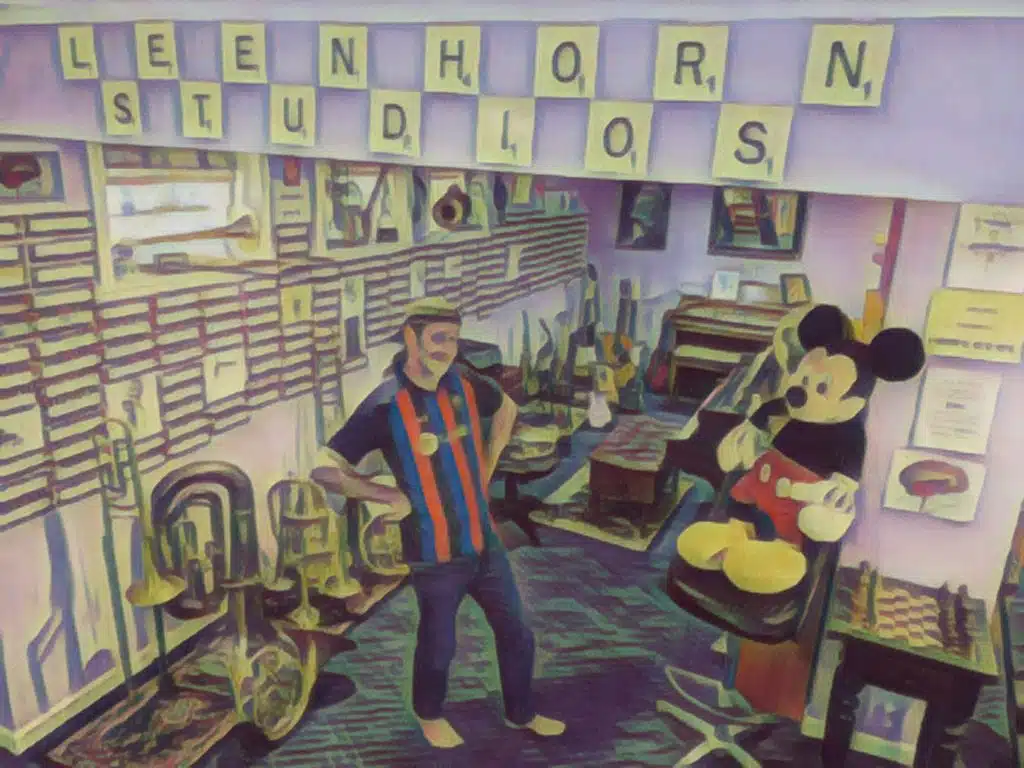
To my spectacular students, sweet souls, your sounds make your mark.
You’ve turned this studio into a symphony, a sanctuary, in the dark.
Each note you’ve played, each risk you’ve taken,
Has taught me truths I may have never awakened.
You show me daily how music moves and magic flows,
In flubbed phrases, fearless tries, and the way your confidence grows.
So thank you, dear dreamers, for teaching me, too.
This isn’t just my studio. It belongs to all of you.