A peaceful warrior embodies the harmonious balance between strength and serenity, recognizing that true power lies not in domination or aggression but in the ability to confront the inner battles that often disrupt our tranquility. This warrior engages with the mind’s chaos, acknowledging fears, doubts, and anxieties without allowing them to dictate their actions.
Through mindfulness, meditation, and self-reflection, they cultivate a deep awareness that empowers them to navigate life’s challenges gracefully. A Peaceful Warrior fights an inner battle that becomes less about external conflict and more about fostering a calm, resilient spirit. One that embraces triumph and adversity.
Courage and Compassion
Winning the inner battle for peace is not a one-time victory but an ongoing process of growth and acceptance. The peaceful warrior understands that moments of struggle and turmoil are integral to the human experience, and rather than resisting these feelings, they learn to flow with them. By transforming pain into purpose and chaos into clarity, they create a sanctuary within themselves.
This inner peace serves as a beacon, guiding them through life’s storms and enabling them to inspire others on their journeys. The peaceful warrior exemplifies the profound truth that serenity arises not from avoiding conflict but from facing it with courage and compassion, thereby achieving a lasting sense of inner harmony.
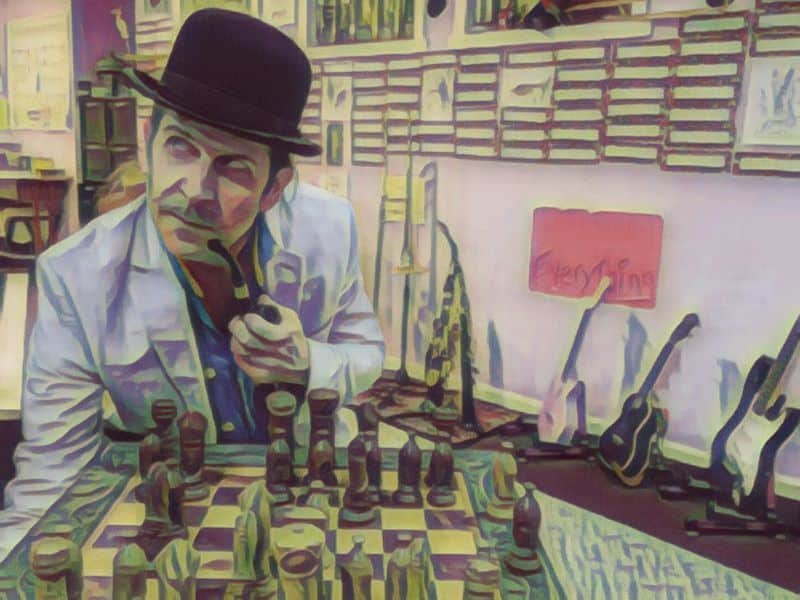
The Human Chess Game
A battle between light and dark with a web of strategies and possibilities, threading through the fog of war on the 64 squares before them. In numerology, 64 is associated with self-determination. It can also represent exploring new ideas and ways of doing things. The pieces represent man’s philosophical constitution, and the light and dark sides encompass every human. There is no place to hide on a chessboard, and the light and shadow are laid out in clear view.
The nature of each chessman is revealed by how it moves. Geometry is the key to their interpretation. In the rooks, the body moves on the square, and in the bishop, the emotions move on the slant. The queens embody the mind, wielding potent intellect and strategy. Pawns embody sensory impulses and perceptive faculties, the building blocks of understanding. The king cannot be captured but loses the battle when he is so surrounded that he cannot escape.
The Kings = The Spirit
The human spirit is an untamable force of resilience and creativity. It rises above adversity to seek meaning and connection. It thrives in pursuing purpose and embodies the boundless potential for growth, love, and transformation.
The Queens = The mind
The human mind is a dynamic engine of thought, constantly processing, analyzing, and interpreting the world around us. It can shape our reality through perception, imagination, and conscious and subconscious thought patterns.
The Bishops = The Emotion
Emotion is the vibrant pulse of human experience, driving our most profound connections and responses to the world. It flows through us like an ever-changing current, guiding our actions, shaping our memories, and coloring our perception of reality.
The Knights = The Vitality
Human vitality is the life force that fuels our physical energy, mental sharpness, and emotional vigor, allowing us to engage fully with the world. It reflects the dynamic balance of our inner strength and health, enabling us to pursue our passions and overcome challenges with resilience and enthusiasm.
The Rooks = The Physical Body
The physical body is a remarkable vessel of strength and complexity, designed to support and sustain life through intricate movement, sensation, and function systems. It is the foundation for our experiences, adapting to external and internal forces while housing the spirit, mind, and emotions.
The Eight Pawns = Senses, Perception, and Soul
The pawns are the only transformative pieces in chess. After making that trip to the end of the board, they transform into any of the pieces. These princesses or future queens encompass consciousness from the human perspective.
They represent the senses and the perception of their information. Sensory impulses are raw data from the external world transmitted through sight, sound, touch, taste, and smell. They act as gateways to our perceptions. The perceptive faculties interpret these impulses, transforming them into experiences, insights, and emotional responses that shape our understanding of reality.
The Eight Pawns of the Soul
The eight parts of the soul, drawn from ancient philosophies, reflect different aspects of our inner nature. Together, these elements form the totality of human experience, from our physical existence to our higher, transcendent aspirations.
- The Vegetative Soul (growth and nourishment) Governs essential survival functions, like digestion and development, ensuring life’s sustenance.
- The Sensitive Soul (sensation and emotion) Manages sensory perception and emotional responses to external stimuli.
- The Imaginative Soul (memory and imagination) Deals with recalling past experiences and creatively imagining new possibilities.
- The Appetitive Soul (desire and will) Directs our desires, inclinations, and motivations toward action.
- The Rational Soul (reason and intellect) Guides logical thought, decision-making, and discernment of truth.
- The Spiritual Soul (connection to the divine or transcendence) Represents our capacity for spiritual awareness and seeking a higher purpose.
- The Animal Soul (instinct and motion) Instinctively directs basic needs, drives, and movement.
- The Intellectual Soul (self-awareness and consciousness) Fosters self-reflection, conscious thought, and the ability to understand complex ideas.
The King and Queen’s Sides
The King’s side is positive, and the Queen’s is adverse, and as with yin and yang, they work best in balance. The light, or positive side of the human, embodies qualities like love, compassion, creativity, and the pursuit of truth, guiding us toward growth, connection, and fulfillment. It reflects our potential for kindness, selflessness, and resilience, shining brightest when we act with purpose, empathy, and a higher awareness.
The dark, or negative side, reveals our inner struggles with fear, anger, greed, and selfishness, often surfacing when we feel threatened or disconnected. This shadow side can lead to destructive behaviors or limiting beliefs, but when acknowledged and understood, it also offers a space for reflection, growth, and transformation. Both light and dark are essential for fully expressing the human experience, offering balance and opportunities for personal evolution.
The Two Kings: The Self and The Ego
The white king symbolizes the self, and the black king symbolizes the ego. The king represents the eternal struggle of each part of man’s compound nature against the shadow of itself. The self is the essence of our identity, grounded in authenticity, awareness, and a deep sense of purpose. It is connected to both inner wisdom and the broader universe. It operates from a place of clarity and love, seeking growth, understanding, and meaningful connection without attachment to external validation.
The false ego, on the other hand, is a constructed identity built from fear, insecurity, and the desire for control or approval. It thrives on illusion, masking the true self with layers of pride, comparison, and attachment to fleeting successes or failures. While the self is rooted in truth and peace, the false ego clings to superficial identities and can keep us in cycles of dissatisfaction until we learn to recognize and transcend it.
A New Kind of War
I propose a new war! Not a war waged with weapons, drones, or destructive technology—no, this is a war of love that transforms the idea of conflict. Imagine a battle not for domination but for understanding, where the ultimate victory is not in defeating others but in guiding them toward the wisdom of peace.
This is a war where the battlefield lies within each of us, a battle fought in everyday moments: at home, in the car, standing in line at the bank. Every time we feel frustration rise, every time we’re tempted to clench our fists, grit our teeth, or strike out in anger—this is our moment to fight differently.
Past Lessons
For too long, we’ve been taught to react to conflict with force, conditioned by centuries of human history, reinforced by media, and passed down through generations. But we are more than our reactions! If we believe we already know what it means to be human, we limit ourselves to old ways of being. We are learning, every moment, what it means to be human, and this war is about expanding those possibilities.
Let’s break free from the habits of the past! Let’s embrace the infinite potential of what it means to live, to grow, to love! There is so much we do not know and many questions we have yet to explore. And that’s the beauty of it! Every second offers us the chance to rewrite the story, to show ourselves and our children a new way.
Oh So Right or Oh So Pleasant
This war is not about who’s right or wrong—it’s about how we respond to the disagreements that naturally arise. The key is love, and love starts within. When we forgive ourselves and each other for our missteps, we begin to dissolve the barriers between us. In doing so, we model for our children a way of being rooted not in conflict but in connection.
This war is one of creation, not destruction. And the battleground? Our hearts, minds, and actions. The future of humanity depends on us! Not in some far-off, abstract sense, but right now—in how we treat one another today. We will know we’ve won when we see our children teaching peace by example, not with words, but through how they live. When frustration turns to patience, patience becomes kindness.
The End of Greed and Violence
We are at a turning point, my friends. Imagine a world where the energies we once poured into defending ourselves are channeled into building something magnificent. A world where the earth can rest, no longer burdened by our greed and violence. In this new world, we will not merely survive but thrive.
Look around you. The people you encounter every day? They are not your adversaries. They are you in another form, walking their path. The next time you feel anger or frustration, well up and pause. Remember: we are all part of the same whole. Let love guide your actions, not just in words but in every breath. The forces of light and dark will swirl around us, but you get to decide whether they control you. When you remain unaffected by the chaos, you become a beacon of peace for others.
The Power of Love
Let this new war be our legacy. Let us fight not with fists but with open hearts as we battle with compassion, not only for ourselves but for all of humanity. Our greatest weapon is love. The kind of love that transforms. In a dark room, one spark of light is visible, but finding darkness is much more difficult in a room full of light.
We are on the cusp of a new age of enlightenment where love and peace are not extraordinary but simply the way things are. Yes, the road ahead is long, and the work will not be easy. The world seems made to foster scared egos defending themselves from their delusions.
Be Peaceful, Pretty Please
So I ask you now, with all the passion and urgency I can muster—will you join me in this war for peace? Will you embrace the power of love and patience to shape a better world? The only thing we have beside ourselves is each other.
The time is now. The world is watching. Our children and their children are waiting for us to lead the way. The future is ours to create, and it begins with the inner peace of the peaceful warrior wielding the power of love as the best and only weapon.
Peaceful Mindfulness
Our minds often run on autopilot in the modern world, reacting to stress, fears, and external demands. Like an untuned instrument, the mind can produce chaotic noise if unchecked. However, by consciously reprogramming our thought patterns, we can transform our minds into instruments of peace, much like St. Francis of Assisi prayed to be.
The Prayer of St. Francis, a beautiful and powerful metaphor asking us to become instruments of peace, is an excellent framework for reprogramming the mind into calmness and love. The prayer begins: “Lord, make me an instrument of your peace. Where there is hatred, let me sow love; Where there is injury, pardon; Where there is doubt, faith; Where there is despair, hope; Where there is darkness, light; And where there is sadness, joy.” I pray to the lord and divine master of my Youniverse, my inner universe, and the peaceful warrior I always strive to be.
Inner Peace Filled Instrument of Peace
To become an instrument of peace, we must first create peace within. This begins with reprogramming the mind to quiet its constant chatter, often filled with doubt, fear, and negativity. We can train ourselves to recognize these disruptive thoughts and, through mindfulness, replace them with thoughts of calm and love.
This is where mental awareness plays a key role. We can ask ourselves: “Is this thought creating peace within me?” If not, we redirect our minds toward gentler, more harmonious thoughts. This gradual shift transforms the mind from a restless, reactive force into a calm, intentional one.
Sowing Love Where There is Hatred
The mind often reacts to negativity with negative patterns: anger, frustration, or hate. To reprogram the mind into an instrument of love, we must replace these reactions with compassion and kindness. This is not just about changing external behavior but the automatic thoughts that arise in difficult situations.
By practicing empathy and seeing others’ perspectives, we shift from reacting with negative energy to actively sowing love in our thoughts and actions. Each time we choose love, we reinforce a peaceful, loving mind.
Bringing Light to Darkness
Fear, doubt, or despair can darken our minds. But just as the prayer asks to bring light to darkness, we can program our minds to seek out positive thoughts even in tough times. This requires consciously illuminating our negative beliefs or emotions with understanding and hope.
When we find ourselves in emotional “darkness,” whether through self-doubt or sadness, we reprogram the mind by practicing gratitude, hope, and positivity, by consistently doing this whenever we feel unsettled, the mind becomes conditioned to seek the light in every situation, even when it’s not immediately apparent.
Finding Joy Where There Is Sadness
Sadness and joy are often considered opposites but coexist when we practice awareness and acceptance. Reprogramming the mind into an instrument of peace involves learning to find light in all circumstances, even amidst sadness. Instead of trying to eliminate sadness, we learn to embrace both and let joy rise from a place of acceptance and love.
This is achieved by reframing our thoughts, finding small moments of beauty or gratitude even during difficult times, and teaching our minds to naturally gravitate toward joy without denying other emotions.
A Heart of Gratitude
The prayer of St. Francis continues with a beautiful call to transcend our inclinations, to let go of selfishness, and to bring about peace in a world that longs for understanding and unity. As a daily meditation, these lines embody gratefulness for the chance to bring light to our lives and the lives of others. “Divine Master, grant that I may not so much seek to be consoled as to console;
to be understood as to understand; to be loved as to love.”
When we look beyond our needs and seek to console, understand, and love others, we transcend our struggles and fears, and something remarkable happens. We find ourselves at peace. Instead of yearning for validation, we step into a humble role as a giver, a peaceful presence. When we console, we offer strength. When we understand, we bridge differences. And when we love, we create a bond that resonates more profoundly than words. Gratitude lies in our ability to heal, listen, and love and recognize that we uplift ourselves and others through these acts. “For it is in giving that we receive; it is in pardoning that we are pardoned; and it is in dying that we are born to eternal life.”
Let Freedom Ring
These final lines capture the paradox of living to the fullest once the ego has died. We fulfill this paradox by giving, loving, and understanding without thinking of ourselves. Each time we extend kindness, patience, or forgiveness, we elevate ourselves, filling the world with compassion, one moment at a time. Giving is transformative, not about loss but abundance, and an act that leaves us feeling more whole. Pardoning does not merely free others from guilt but liberates us from the weight of resentment, renewing our spirits.
And in “dying,” we are reminded of the power of surrender. Letting go of our egos, fears, and needs to control outcomes. These little “deaths” connect the inner peace we’ve cultivated with an eternal sense of peace that settles the souls around us. There is gratefulness in every act of release that reveals the vast, open space of inner freedom and joy. This “dying to self” does not take from us but eliminates the weights holding us down, allowing us to become more fully alive, in tune with our quiet, enduring strength within.
An Instrument of Peace
In this journey, we train our minds to serve peace. In St. Francis of Assisi’s prayer, he asks to be made “an instrument of peace,” seeking to bring love where there is hatred and light where there is darkness. Likewise, the peaceful warrior aligns thoughts and actions with a calm inner resolve, redirecting the mind from reaction to reflection.
By sowing seeds of love and understanding within our minds, we reprogram our responses, choosing compassion over anger and patience over frustration. With each choice, the mind becomes less chaotic, an instrument finely tuned to create harmony rather than discord.
Join the Journey
The path of the peaceful warrior isn’t easy, but it’s a choice that transcends the cycles of reaction that fuel conflict in the world. By cultivating this inner peace, we build a legacy of love, patience, and resilience that echoes far beyond our lives. As we step into this role, we contribute to a collective shift towards peace, radiating compassion and understanding in a world that deeply needs both. Our children and communities will inherit our actions and the energy we bring to them. An energy that can heal, inspire, and transform.
Will you join this inner revolution? Will you walk the peaceful warrior’s path, wielding love as your most potent weapon? When we choose peace, we light the way for others, transforming our communities, relationships, and ourselves. Let’s embrace the strength within and be guided by the wisdom that true power lies in inner peace and compassion.
A Warrior for Peace
St. Francis’ prayer can be seen as a blueprint for tuning the mind into a more peaceful, loving, and harmonious instrument. We cultivate peace, love, and joy from within by consciously reprogramming our thought patterns. Each part of the prayer invites us to reexamine how we think and respond to life, allowing us to move beyond reactive patterns toward a more intentional, loving mindset.
In my experience teaching musicians and chess players, I see the same truth echoed: the mind’s chatter frequently prevents us from letting our instincts take over. This leads us to a different battle, which takes place within our thoughts’ theater. A benefit to playing this inner game as a peaceful warrior is the quieting of the mind, and just as a musician must practice to perfect their craft, this mental reprogramming takes time and effort. But as we work on it, we can turn the mind into an instrument that brings peace, love, and light not only to ourselves but to everyone around us.